" height="11.991146877189792px" id="Fw_A518OF" transform="translate(13.223 4.764)" width="61.7416767958389px"/><path d="M 0 1.432 C 0 0.641 0.641 0 1.432 0 C 2.223 0 2.864 0.641 2.864 1.432 C 2.864 2.223 2.223 2.864 1.432 2.864 C 0.641 2.864 0 2.223 0 1.432 Z" fill="rgb(32, 44, 64)" height="2.8637104577078727px" id="nLs7Z6VVX" transform="translate(58.857 1.245)" width="2.863710457707782px"/><path d="M 48.654 9.507 L 48.654 4.544 C 48.654 4.4 48.561 4.284 48.452 4.284 L 46.511 4.284 C 46.399 4.284 46.309 4.4 46.309 4.544 L 46.309 4.765 C 43.908 2.927 40.511 3.17 38.397 5.333 C 36.282 7.495 36.115 10.896 38.007 13.256 C 39.899 15.615 43.255 16.191 45.825 14.597 C 45.875 14.566 45.924 14.535 45.972 14.504 C 46.087 14.427 46.199 14.346 46.309 14.261 L 46.309 15.028 C 46.309 15.172 46.402 15.288 46.511 15.288 L 48.452 15.288 C 48.563 15.288 48.654 15.172 48.654 15.028 Z M 42.668 12.666 C 41.391 12.666 40.239 11.897 39.75 10.717 C 39.262 9.537 39.532 8.179 40.435 7.275 C 41.338 6.372 42.696 6.102 43.876 6.591 C 45.056 7.079 45.825 8.231 45.825 9.508 C 45.825 11.252 44.412 12.666 42.668 12.666 Z M 10.504 8.754 C 10.473 5.872 8.127 3.554 5.245 3.557 C 2.364 3.561 0.023 5.885 0 8.767 L 0.004 8.767 L 0.004 15.095 C 0.004 15.164 0.11 15.268 0.242 15.268 L 2.536 15.268 C 2.668 15.268 2.775 15.164 2.775 15.095 L 2.775 8.766 C 2.775 7.396 3.886 6.286 5.256 6.286 C 6.626 6.286 7.737 7.396 7.737 8.766 L 7.74 8.766 L 7.74 15.099 C 7.74 15.168 7.847 15.272 7.978 15.272 L 10.272 15.272 C 10.405 15.272 10.511 15.168 10.511 15.099 L 10.511 8.754 Z M 17.661 13.006 C 17.27 12.968 16.89 12.855 16.543 12.672 C 15.919 12.346 15.529 11.699 15.532 10.995 L 15.532 6.332 L 17.638 6.332 C 17.769 6.332 17.875 6.226 17.875 6.096 L 17.893 3.989 C 17.893 3.927 17.868 3.866 17.824 3.822 C 17.779 3.778 17.719 3.753 17.656 3.753 L 15.55 3.753 L 15.532 0.237 C 15.532 0.106 15.426 0 15.295 0 L 13.025 0 C 12.894 0 12.788 0.106 12.788 0.237 L 12.788 3.76 L 11.79 3.76 C 11.721 3.76 11.655 3.787 11.606 3.836 C 11.557 3.884 11.529 3.951 11.529 4.02 L 11.529 6.083 C 11.529 6.227 11.646 6.344 11.79 6.344 L 12.79 6.344 L 12.78 11.063 C 12.776 12.364 13.398 13.587 14.45 14.35 L 14.471 14.365 C 15.39 15.06 16.502 15.454 17.654 15.491 C 17.718 15.492 17.779 15.467 17.825 15.422 C 17.87 15.376 17.895 15.315 17.894 15.251 L 17.873 13.247 C 17.87 13.126 17.781 13.024 17.661 13.006 Z" fill="rgb(32, 44, 64)" height="15.4952508407603px" id="qwDNIe0aq" transform="translate(38.812 1.259)" width="48.65373378361464px"/><path d="M 2.431 0.839 C 2.587 0.342 3.069 0 3.616 0 L 6.977 0 C 7.396 0 7.738 0.326 7.738 0.723 L 7.738 0.725 C 7.732 0.851 7.697 0.974 7.635 1.084 L 1.423 10.241 C 1.301 10.437 1.004 10.598 0.764 10.598 C 0.345 10.598 0 10.274 0 9.875 C 0.001 9.821 0.008 9.767 0.02 9.714 Z" fill="rgb(19, 194, 194)" height="10.597965239271957px" id="f3yZqWXvl" transform="translate(1.286 7.402)" width="7.737982357818822px"/><path d="M 5.306 9.759 C 5.151 10.256 4.669 10.598 4.122 10.598 L 0.761 10.598 C 0.342 10.598 0 10.272 0 9.875 L 0 9.873 C 0.006 9.747 0.041 9.624 0.102 9.514 L 6.315 0.357 C 6.437 0.161 6.734 0 6.974 0 C 7.396 0 7.738 0.326 7.738 0.723 C 7.736 0.777 7.73 0.831 7.718 0.884 Z" fill="rgb(46, 162, 248)" height="10.597965239271959px" id="dYausqZzp" width="7.737516410786981px"/><path d="M 2.228 2.355 L 2.868 0 L 1.825 0 C 1.278 0 0.795 0.341 0.64 0.839 L 0 3.193 L 1.044 3.193 C 1.591 3.193 2.073 2.852 2.228 2.355 Z" fill="rgb(42, 148, 226)" height="3.192669062189114px" id="yO4fO7gG7" transform="translate(3.078 7.404)" width="2.8683699280263113px"/></g></svg>)
Opening Access to Centris Data: What Toronto Taught Us
The APCIQ will open access to Centris data within a year. What Toronto’s experience can teach Quebec’s real estate brokers and agencies.
Published
•
UpDATEd

Felix Loiselle
Head of Growth

At a Glance
On October 15, 2026, Quebec Association of Real Estate Brokers and Agency Owners (APCIQ) reached an agreement on access to Centris data.
Within a year, the APCIQ will provide its members with a data feed that includes sales prices and listing history.
Toronto went through the same shift in 2018: brokerages built new tools within a strict framework governing access and use.
In Quebec, Bill 25 and the Real Estate Brokerage Act will govern implementation.
The agreement on access to Centris data, reached on October 15, 2026, between the Competition Bureau and the APCIQ, did not come out of nowhere. The Bureau itself describes it as a follow-up to the Toronto Real Estate Board case, decided in 2016 and upheld in 2018.
Quebec therefore has a rare advantage: eight years of hindsight on what happens when access to real estate data opens up. Here is what Toronto taught us, and what brokers and agencies here can learn from it.
Two Cases, the Same Rationale

In both Toronto and Quebec, the Competition Bureau challenged restrictions imposed by an association that controlled access to its members’ data.
Date | Market | Milestone |
|---|---|---|
October 2026 | Quebec | Agreement between the Bureau and the APCIQ, effective for ten years |
2025 | Quebec | Second court order to continue the investigation |
2023 | Quebec | First court order concerning the APCIQ |
August 2018 | Toronto | The Supreme Court declines to hear TRREB’s appeal |
2016 | Toronto | The Competition Tribunal rules in favor of the Bureau |
May 2011 | Toronto | The Bureau files its application against TRREB |
In Toronto, the dispute centered on two issues: the ban on displaying sold prices on brokers’ secure online platforms, and the exclusion of that data from the feed provided to members. TRREB cited privacy concerns; the Tribunal concluded that it already had the consent needed to display the data.
What Happened After Access Opened Up
Shortly after the Supreme Court’s decision, TRREB provided its members with a data feed that included sales. Several brokerages quickly built search tools inspired by major American portals, some displaying more than a decade of sales history.

“We’ve been following the TRREB case for more than five years because we knew Quebec would eventually follow. What struck us most was how quickly buyers’ expectations changed. Once sold prices became available online, nobody wanted to go back. Brokers who had the right tools from the start earned their clients’ trust. The others spent years catching up with tech-driven brokerages that had invested in the online experience before they did.”
Julien Fiset, Head of Strategy at Centiva
Open Access Did Not Mean No Rules
Toronto also shows that opening access to data comes with a framework, and those who ignore it have to backtrack.

Protected access: Consumers had to use a secure platform operated by a member. Several brokerages that initially displayed sales without requiring registration had to comply.
No resale: TRREB warned that the data could not be scraped, resold or monetized.
Limited history: TRREB eventually limited the display of sold data to two years.
Advertising rules: Ontario’s regulator clarified that displaying sales on these platforms does not constitute advertising, but advertising rules still apply elsewhere.
The lesson: the tools that lasted were designed to comply with the framework from the outset.
The Mistake to Avoid: Losing the Client Relationship
When access to data opens up, the real question is not who has access, but who uses it to benefit the client. That is where everything is decided.
“In Toronto, access to data opened up, but traditional brokers weren’t always the ones who benefited. Other players, quicker to adopt technology, captured the client relationship. In Quebec, we have an opportunity to do the opposite: make this shift strengthen your connection with your clients instead of putting you in competition with a portal.”
Julien Fiset, Head of Strategy at Centiva
Why Quebec Will Not Simply Copy Toronto
The APCIQ itself has pointed out that Quebec’s laws are more restrictive than those in the rest of Canada, particularly when it comes to personal information. It plans to implement the changes within the framework of the Real Estate Brokerage Act and Quebec’s Personal Information Protection Act.
“Quebec plays by its own rules: Centris has a very strong presence among the public, Law 25 strictly regulates privacy, and players from the rest of Canada are less familiar with the French-speaking market. For brokers here, that’s an advantage, provided they’re ready before others arrive with their tools.”
Julien Fiset, Head of Strategy at Centiva
In other words, tools that work in Toronto or the United States cannot simply be transplanted here. They will need to be designed for Quebec’s regulatory framework.
An Eight-Year Head Start, If We Use It
Toronto learned as it went. Quebec can learn by observing: buyers’ expectations will evolve quickly, the framework will matter as much as the tools, and the client relationship will go to those who are ready.
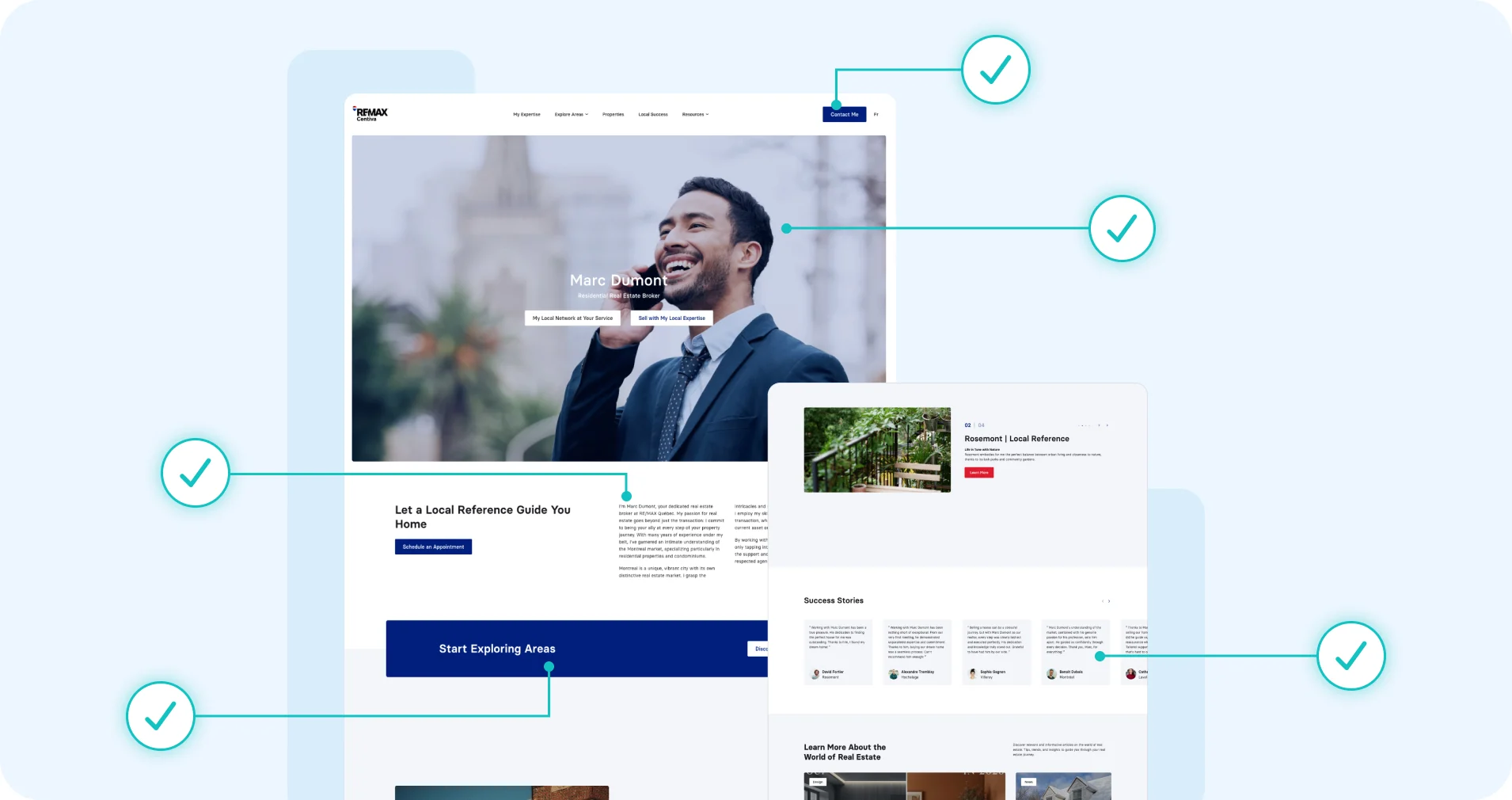
Want to prepare your website and tools for this market shift? Talk to your Centiva strategist.
Frequently Asked Questions
What is the agreement between the Competition Bureau and the APCIQ? It is a consent agreement reached on October 15, 2026, and registered with the Competition Tribunal for ten years. Under the agreement, the APCIQ commits to providing its members with a real estate data feed sourced from Centris.
What data will be available? The feed will include sale prices, listing history and properties’ physical characteristics, among other information.
When will the data feed be available? The APCIQ plans to implement all measures over the next year. Technical details have not yet been published.
Will buyers be able to view sold prices? According to the APCIQ, brokers will be able to provide access to certain data, including information on sold properties, as part of their client relationship and through secure platforms.
What can Quebec brokers learn from Toronto’s experience? In Toronto, the opening of access in 2018 allowed brokerages to create new tools, but within a strict framework: protected access, a ban on reselling data and a two-year limit on sales history. The tools that lasted complied with that framework from the start.
Sources
Subscribe to the newsletter
Stay up-to-date with the latest features and news in proptech
An Eight-Year Head Start, If We Use It
Want to prepare your website and tools for this market shift? Talk to your Centiva strategist.
Share